Scientists from around the world are at Brown to discuss what is known, and what needs to be learned, about the long-sought particle discovered a decade ago.
Read Article
Physics
Meenakshi Narain
Professor
Biography
Professor Meenakshi Narain earned her Ph.D. in Physics from the State University of New York, Stony Brook. She had an Sc.B. degree from Gorakhpur University in India and an Sc.M. in Physics from Indian Institute of Technology, Kanpur, India. In 2012, she was elected a Fellow of the LHC Physics Center at Fermilab, where she served as Coordinator promoting collaboration with colleagues from South America, Europe, India, and Iran. In 2000, she earned an Outstanding Junior Investigator Award from the U.S. Department of Energy (DOE) and a National Science Foundation Faculty Early Career Development Award
Professor Narain joined the Brown University Department of Physics faculty in 2007 and was the first woman to chair the department, beginning on July 1, 2022.
News from Brown
Meenakshi Narain, an accomplished high-energy experimentalist and a longtime professor of physics at Brown University, died on Sunday, Jan. 1, at age 58. Narain joined Brown’s Department of Physics faculty in 2007 and had served as department chair since July 2022 — the first woman to hold that role in the department’s history.
A prominent physicist who collaborated with researchers across the globe, Narain was deeply involved with the Compact Muon Solenoid (CMS) experiment at the Large Hadron Collider particle accelerator at CERN in Switzerland, as well as the DØ experiment at Fermilab, the U.S. Department of Energy’s particle physics and accelerator laboratory.
Narain conducted pioneering research on the Higgs Boson, which upon its discovery in 2012 was the final missing piece in the Standard Model of particle physics. An author on more than 850 peer-reviewed studies in leading physics journals, she spearheaded a multidisciplinary effort to bring advanced quantum sensing and quantum computing techniques to high-energy physics, and was instrumental in discovering the top quark, the heaviest fundamental particle, in 1995.
Vesna Mitrovic, a professor of physics and engineering at Brown, said that much of Narain’s success stemmed from the courage to tackle complex questions in physics: “Often, it’s easy to find a million reasons why you shouldn’t take on a particular challenge — it’s too difficult, or it will take too much time,” Mitrovic said. “This was not Meenakshi. She’d say: ‘What is it that we could do better? Let’s jump on it.”
Mitrovic said that Narain brought a unique mix of kindness, generosity and a drive for excellence and professionalism. She was demanding, Mitrovic said, but would support her students and faculty colleagues in meaningful and concrete ways.
“She was a truly special, amazing friend to me,” Mitrovic said. “What I really appreciated was that in the physics department, we worked as professional colleagues and even when we didn’t agree, she was amazingly professional. For someone to be that warm of a friend and human outside of the department, yet when it comes to work to be so incredibly ethical and professional, that’s unique. This is what made Meenakshi so successful.”
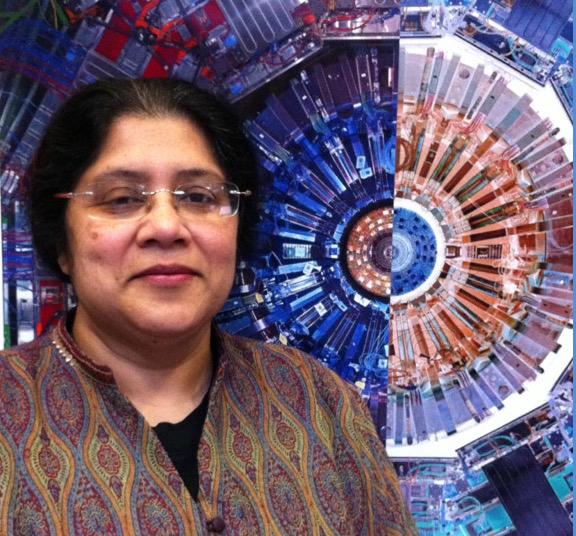
In an “In Memoriam” tribute published by Fermilab, the United States leadership team on the CMS experiment noted that Narain’s “impact on CMS has been immeasurable and her many contributions have been critical to the success of the collaboration.” Narain had served as a member of the CMS Management Board as the U.S. regional representative, chair of the U.S. CMS Collaboration, and a leader of the CMS group from Brown. She was also a founding chair of the CMS Diversity Office and a leader of the CMS Women’s Forum.
Narain was a strong and persistent advocate for diversity and inclusion in physics at Brown and well beyond. She served as a member of the CMS Task Force on Diversity and Inclusion and engaged in STEM outreach activities to encourage the participation of young women in science. She organized multiple Conferences for Undergraduate Women in Physics at Brown, and was a mentor and faculty advisor of the Department of Physics’ Women in Science and Engineering group.
Janet Blume, deputy provost and an associate professor of engineering, worked with Narain since her arrival at Brown — first as fellow women physical sciences faculty in the University’s Barus and Holley building.
“Meenakshi was a strong voice for women and underrepresented minorities in physics and was committed to making it a field that is free of barriers,” Blume said. “She worked toward that goal as tirelessly as she did her amazing research program. She showed incredible generosity in mentoring individual physicists at all levels, providing encouragement, tutelage and an exemplary role model. I know there are countless physicists who point to Meenakshi as the person to whom they owe their success.”
Narain was also the organizer and founder of the Big Bang Science Fair at WaterFire Providence, a public outreach event that brought hands-on science experiences to local kids and community members.
“Meenakshi had the inner strength and focus to develop a wide network of people who would work together, excited by her vision, to make possible some major accomplishment,” said Brown Professor Emeritus of Physics David Cutts, a longtime colleague. “An example is the Big Bang Science Fair at WaterFire, which pulled together contributions from the sciences and arts to spectacular success. To see what one could do through one’s will was inspiring not only to those she mentored, but also to many others whom she touched.”
Professor of Physics Ian Dell’Antonio said that as an undergraduate advisor, he’s met many students who Narain mentored: “It’s remarkable how many students would say that they would not have succeeded in physics except for her mentorship,” he said. “Meenakshi had this great ability to make people feel heard and valued. She would take students in their first or second year under her wing and make sure they got the encouragement, advice — and sometimes talking to — they needed to succeed. Her students are fiercely devoted to her.”
Dell’Antonio added that Narain worked ceaselessly to promote physics well beyond the academic community.
“She was also constantly looking for ways to promote other public-facing aspects of physics,” he said. “In particular, she was a huge supporter of Ladd Observatory and its public engagement, and was constantly pushing me and the other astronomers to be more visible.”
Blume noted that Narain took on the role of chair of the Department of Physics this year, despite existing responsibilities that included research, leadership in worldwide physics communities, and a devotion to teaching and mentoring. In her short time as department chair, Narain was exceptional, Blume said.
“Being chair of any department is a challenge, but it is an especially complex role in a department like physics, with its ambitious and successful research agenda, sophisticated laboratories, high levels of external funding, multiple degree programs, and wide ranges of courses,” Blume said. “Meenakshi welcomed the challenge — even while facing health challenges — and took a calm, methodical and thoughtful approach. Any chair has to work with department faculty, staff and students, but also the University administration. Meenakshi managed to be an outstanding partner to all. She was one of a kind and will be terribly missed.”
Narain’s work earned her a wide array of accolades throughout her career. In 2000, she received both an Outstanding Junior Investigator Award from the U.S. Department of Energy and a National Science Foundation Early Career Development Award. In 2007, she was elected a fellow of the American Physical Society. And in 2012, she was elected a fellow of the LHC Physics Center at Fermilab. Recently, Narain served on the Department of Energy’s High Energy Physics Advisory Panel, and she was just chosen as a member of the panel’s P5 subpanel, which will advise the U.S. government on priorities for the field.
Narain earned a bachelor of science from Gorakhpur University in India; a master of science in physics from Indian Institute of Technology, Kanpur, India, which recently awarded her a distinguished alumna award; and a Ph.D. in physics from the State University of New York at Stony Brook.
Narain is survived by her husband — Ulrich Heintz, a fellow professor of physics at Brown — and sons Aneesh and Anand Heintz.
This story includes reporting from a Department of Physics tribute to Meenakshi Narain, which is available in full on the department’s website.
Research
Professor Narain was deeply involved with the Compact Muon Solenoid (CMS) experiment at the Large Hadron Collider (LHC) at CERN and the DØ experiment at Fermilab. She was elected a Fellow of the American Physical Society in 2007. A prominent high energy experimentalist, Professor Narain was deeply involved with the Compact Muon Solenoid (CMS) experiment at the Large Hadron Collider (LHC) at CERN and the DØ experiment at Fermilab. She conducted pioneering research on the Higgs boson and other fundamental particles and spearheaded a multidisciplinary effort to bring advanced quantum sensing and quantum computing techniques to high energy physics. She was instrumental in discovering the top quark, the heaviest fundamental particle, in 1995.
Publications
Professor Narain authored or co-authored over 850 articles in leading physics journals.
Recent News
CERN hails the late Meenakshi Narain as an "inspirational leader and champion of diversity in CMS and beyond" with PURSUE legacy
Read Article
2023 APS CUWiP at Brown
2023 CUWiP at Brown
Professor Vesna Mitrovic opened the 2023 CUWiP at Brown on Friday evening with introductory remarks, including a reflection of Dr. Meenakshi Narain’s impact on women in physics: “There isn’t anybody better that you should aim to be like.”
CUWiP at Brown
By Valerie DeLaCámara
The Conference for Undergraduate Women in Physics (CUWiP) is a network of three-day regional conferences designed to increase participation and retention of women and underrepresented minorities in physics. The conferences connect undergraduate women in physics with mentors who range in age from graduate students to faculty. Through keynote speakers, workshops and activities, undergraduate women are provided with a unique opportunity to learn all that a future in physics can hold for them. The American Physical Society (APS) is the institutional home of the conferences, which are supported in part by the National Science Foundation and by the Department of Energy. The host sites are chosen through a rigorous selection process, in which the APS expects applications to “demonstrate a clear commitment to the goals of the CUWiP program, both on the part of the institution and members of the local organizing committee,” with involvement of both students and faculty.
Brown Physics Professor Meenakshi Narain successfully lobbied for Brown to be named a host site of the January 2023 CUWiP, at which thirty universities were represented, including Amherst College, Baldwin Wallace University, Bowling Green State University, Brown University, Case Western Reserve University, Clarkson University, College of the Holy Cross, Hunter College, Massachusetts College of Liberal Arts, Miami University, Mount Holyoke College, Naugatuck Valley Community College, Oberlin College, Ohio Northern University, Ohio State University, Ohio University, Ohio Wesleyan University, Providence College, Southern Connecticut State University, University of Cincinnati, University of Connecticut, University of Dayton, University of Massachusetts Amherst, University of Rhode Island, Wesleyan University, Williams College, Wittenberg University, and Yale University.
Prof. Narain reached out to those she considered to be outstanding women in physics and her call was answered resoundingly by some of the most prominent names in the field, including Professors Nandini Trivedi, OSU; Toyoko Orimoto, Northeastern; Jenny Hoffman, Harvard; Beth Parks, Colgate University; Julianne Pollard-Larkin, UT Austin, MD Anderson Cancer Center; Mirna Mihovilovic, Syracuse University and Brown Ph.D. Alumnus; Savannah Thais, Columbia; Sarah Demers, Yale; Jung-Eun Lee, Brown DEEPS; Li-Qiong Wang, Brown Chemistry; Geraldine Cochran, Rutgers; Brown University Vice President for Research Jill Pipher; Brown University’s Vice President for Institutional Equity and Diversity Dr. Sylvia Carey-Butler and Dean Janet Blume.
Since hosting a CUWiP is an enormous undertaking, the APS provides some logistical assistance for each host site’s conference; however, the majority of the work is done by the host site faculty sponsor, along with their team of volunteers. The Brown physics community showed up in numbers, with more than 40 volunteers of physics master’s and Ph.D. students, five faculty, two undergraduates, and two volunteers from Brown DEEPS.
Upon Prof. Narain’s unexpected passing two weeks before the conference, Professor Vesna Mitrović stepped in as the conference faculty lead. Prof. Mitrović relied heavily upon Daniel Li, Prof. Narain’s graduate student of almost five years, as he stepped up as CUWiP at Brown’s chief organizer. Read more about Daniel on page 26.
Prof. Mitrović now faced the difficult task of speaking in a timeslot reserved for her late friend.
With remarks that both elegized and elevated Prof. Narain, Prof. Mitrović quietly opened the conference, saying, “I’m unfortunately standing here because our chair – who really organized everything – Professor Meenakshi Narain, left us two weeks ago. I want to dedicate tonight as an homage to her. She was too quiet about all the things she did, but I can’t think of any better role model – I know you’re going to hear from fantastic speakers tomorrow – but I really cannot think of anybody better that you should aim to be like. My colleague and friend Meenakshi was an amazing physicist, but she also really cared about helping both women and underrepresented groups in physics succeed.”
Brown Vice President for Institutional Equity and Diversity Dr. Sylvia Carey-Butler reflected on Prof. Narain’s efforts to further opportunities within physics for underrepresented groups, saying, “Losing Meenakshi is a tremendous loss in so many ways. One of the areas of responsibility that I’ve had is overseeing the Brown/Tougaloo partnership; we are celebrating almost 60 years in 2024. Meenakshi played a significant role both in partnership and advancing physics and physics research at Tougaloo College. In early December, we celebrated the award of a grant of just under $1 million that Meenakshi received on behalf of Tougaloo College; we were very excited. I shared that with President Paxson and Tougaloo College's president, Dr. Walters. Meenakshi was just so excited. We were looking at ways in which the Office of Institutional Equity and Diversity could support her involvement with a HEP renewable grant. Meenakshi also oversaw the Physics Honors Program Society at Tougaloo College; she was involved in furthering opportunities for women in physics and championing equity and diversity in physics. It is a tremendous loss to both the students and the faculty that she influenced at Brown University and on Tougaloo’s campus. I considered her a colleague and a friend and will miss her tremendously, but in her name the work will continue and we will honor her legacy. She was quietly wonderful in all she did, and I am glad I had a chance to work with her.”
Read more about CUWiP at Brown here: https://sites.brown.edu/cuwip/
Read Article
CUWiP at Brown
By Valerie DeLaCámara
The Conference for Undergraduate Women in Physics (CUWiP) is a network of three-day regional conferences designed to increase participation and retention of women and underrepresented minorities in physics. The conferences connect undergraduate women in physics with mentors who range in age from graduate students to faculty. Through keynote speakers, workshops and activities, undergraduate women are provided with a unique opportunity to learn all that a future in physics can hold for them. The American Physical Society (APS) is the institutional home of the conferences, which are supported in part by the National Science Foundation and by the Department of Energy. The host sites are chosen through a rigorous selection process, in which the APS expects applications to “demonstrate a clear commitment to the goals of the CUWiP program, both on the part of the institution and members of the local organizing committee,” with involvement of both students and faculty.
Brown Physics Professor Meenakshi Narain successfully lobbied for Brown to be named a host site of the January 2023 CUWiP, at which thirty universities were represented, including Amherst College, Baldwin Wallace University, Bowling Green State University, Brown University, Case Western Reserve University, Clarkson University, College of the Holy Cross, Hunter College, Massachusetts College of Liberal Arts, Miami University, Mount Holyoke College, Naugatuck Valley Community College, Oberlin College, Ohio Northern University, Ohio State University, Ohio University, Ohio Wesleyan University, Providence College, Southern Connecticut State University, University of Cincinnati, University of Connecticut, University of Dayton, University of Massachusetts Amherst, University of Rhode Island, Wesleyan University, Williams College, Wittenberg University, and Yale University.
Prof. Narain reached out to those she considered to be outstanding women in physics and her call was answered resoundingly by some of the most prominent names in the field, including Professors Nandini Trivedi, OSU; Toyoko Orimoto, Northeastern; Jenny Hoffman, Harvard; Beth Parks, Colgate University; Julianne Pollard-Larkin, UT Austin, MD Anderson Cancer Center; Mirna Mihovilovic, Syracuse University and Brown Ph.D. Alumnus; Savannah Thais, Columbia; Sarah Demers, Yale; Jung-Eun Lee, Brown DEEPS; Li-Qiong Wang, Brown Chemistry; Geraldine Cochran, Rutgers; Brown University Vice President for Research Jill Pipher; Brown University’s Vice President for Institutional Equity and Diversity Dr. Sylvia Carey-Butler and Dean Janet Blume.
Since hosting a CUWiP is an enormous undertaking, the APS provides some logistical assistance for each host site’s conference; however, the majority of the work is done by the host site faculty sponsor, along with their team of volunteers. The Brown physics community showed up in numbers, with more than 40 volunteers of physics master’s and Ph.D. students, five faculty, two undergraduates, and two volunteers from Brown DEEPS.
Upon Prof. Narain’s unexpected passing two weeks before the conference, Professor Vesna Mitrović stepped in as the conference faculty lead. Prof. Mitrović relied heavily upon Daniel Li, Prof. Narain’s graduate student of almost five years, as he stepped up as CUWiP at Brown’s chief organizer. Read more about Daniel on page 26.
Prof. Mitrović now faced the difficult task of speaking in a timeslot reserved for her late friend.
With remarks that both elegized and elevated Prof. Narain, Prof. Mitrović quietly opened the conference, saying, “I’m unfortunately standing here because our chair – who really organized everything – Professor Meenakshi Narain, left us two weeks ago. I want to dedicate tonight as an homage to her. She was too quiet about all the things she did, but I can’t think of any better role model – I know you’re going to hear from fantastic speakers tomorrow – but I really cannot think of anybody better that you should aim to be like. My colleague and friend Meenakshi was an amazing physicist, but she also really cared about helping both women and underrepresented groups in physics succeed.”
Brown Vice President for Institutional Equity and Diversity Dr. Sylvia Carey-Butler reflected on Prof. Narain’s efforts to further opportunities within physics for underrepresented groups, saying, “Losing Meenakshi is a tremendous loss in so many ways. One of the areas of responsibility that I’ve had is overseeing the Brown/Tougaloo partnership; we are celebrating almost 60 years in 2024. Meenakshi played a significant role both in partnership and advancing physics and physics research at Tougaloo College. In early December, we celebrated the award of a grant of just under $1 million that Meenakshi received on behalf of Tougaloo College; we were very excited. I shared that with President Paxson and Tougaloo College's president, Dr. Walters. Meenakshi was just so excited. We were looking at ways in which the Office of Institutional Equity and Diversity could support her involvement with a HEP renewable grant. Meenakshi also oversaw the Physics Honors Program Society at Tougaloo College; she was involved in furthering opportunities for women in physics and championing equity and diversity in physics. It is a tremendous loss to both the students and the faculty that she influenced at Brown University and on Tougaloo’s campus. I considered her a colleague and a friend and will miss her tremendously, but in her name the work will continue and we will honor her legacy. She was quietly wonderful in all she did, and I am glad I had a chance to work with her.”
Read more about CUWiP at Brown here: https://sites.brown.edu/cuwip/