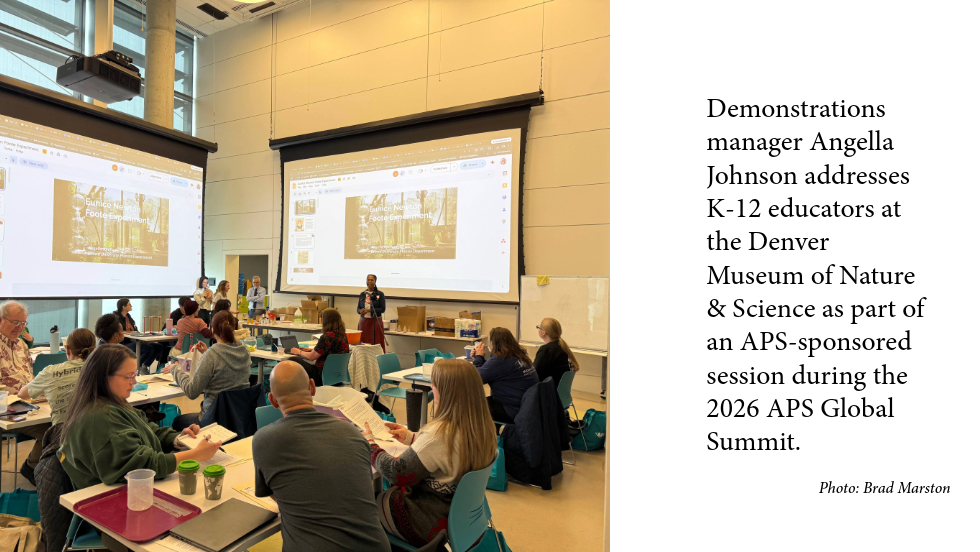
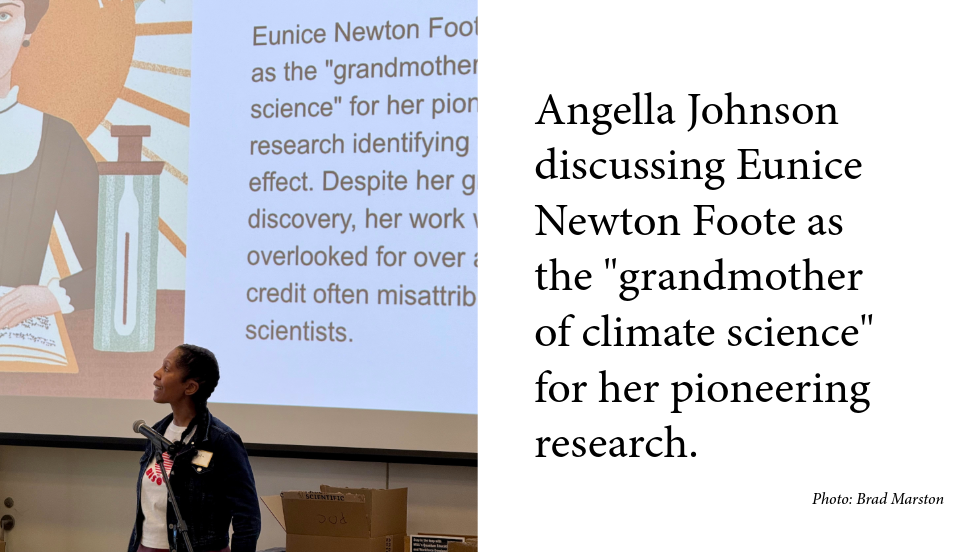
While presenting the APS-sponsored session “Making Physics Real: Interactive Activities in Soft Matter, Climate and Beyond,” to a crowd of K–12 educators at the Denver Museum of Nature & Science, Brown physics demonstrations manager Angella Johnson introduced teachers to the work of Eunice Newton Foote, often described as the “grandmother of climate science.”
Johnson explained that “using simple glass cylinders and thermometers, [Foote] experimentally demonstrated that carbon dioxide and water vapor trap heat, concluding that an atmosphere rich in these gases would increase Earth's temperature.” Despite her groundbreaking discovery, said Johnson, “her work was largely overlooked for over a century, with credit often misattributed to male scientists.”
In a hands-on experiment, teachers used water bottles, thermometers, baking soda, and vinegar to produce carbon dioxide gas. Using infrared light, the demonstration let students directly observe how CO₂ retains heat, making the process visible and measurable.
“The goal is to show students that climate science isn’t distant or theoretical, it’s something you can see and test,” Johnson said.
The demonstration also covers the chemistry involved: a rapid reaction of sodium bicarbonate and acetic acid produces carbon dioxide, water, and sodium acetate. The fizz engages students, and temperature changes reinforce the heat-trapping concept.
APS President Brad Marston aims to increase APS's support for science educators through programs like Johnson’s demonstration.
Marston observed that “Angella did a great job presenting the climate demonstrations that she developed for K–12 science teachers this morning at the Denver Museum of Nature & Science.”
Johnson’s demonstrations highlight the APS Global Physics Summit's focus: connecting fundamental physics to global challenges like climate change and providing educators with tools to bring that knowledge into their classrooms.
In relating Foote’s story, Johnson points out that science isn’t just about big ideas, but also about whose work is recognized. Through simple experiments and inclusive stories, she inspires students to see themselves as contributors to the history of science.